

Bringing people into the ocean conversation
How can ocean governance be truly sustainable if the rights of the people who depend on, work on, and move across the ocean are overlooked?
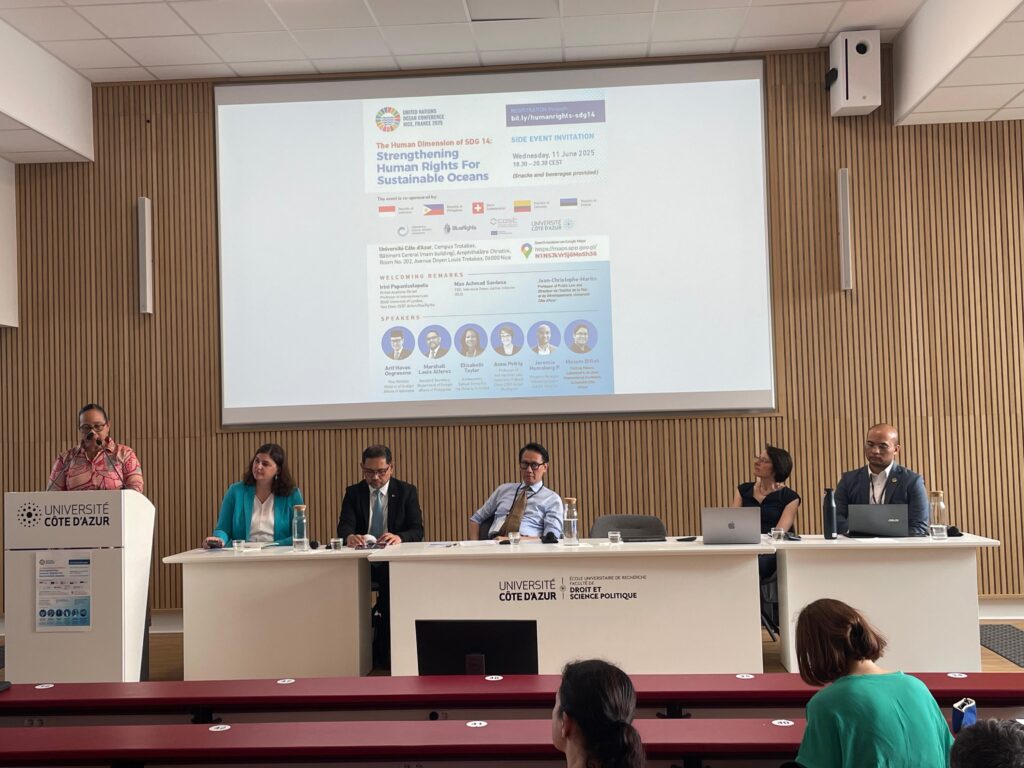
Held during the Third United Nations Ocean Conference in Nice, this high-level side event brought together government representatives, international law experts, academics, and ocean justice advocates to explore the human dimension of Sustainable Development Goal 14.
The discussion focused on a central BlueRights concern: ocean sustainability is not only about ecosystems and resources. It is also about the people whose lives, livelihoods, safety, dignity, and rights are tied to the sea.
The event was co-sponsored by the Republic of Indonesia, the Republic of the Philippines, the Swiss Confederation, the Republic of Colombia, and the Republic of Estonia, together with the Indonesia Ocean Justice Initiative (IOJI), BlueRights, and Université Côte d’Azur.
Who took part?
Welcoming remarks were delivered by:
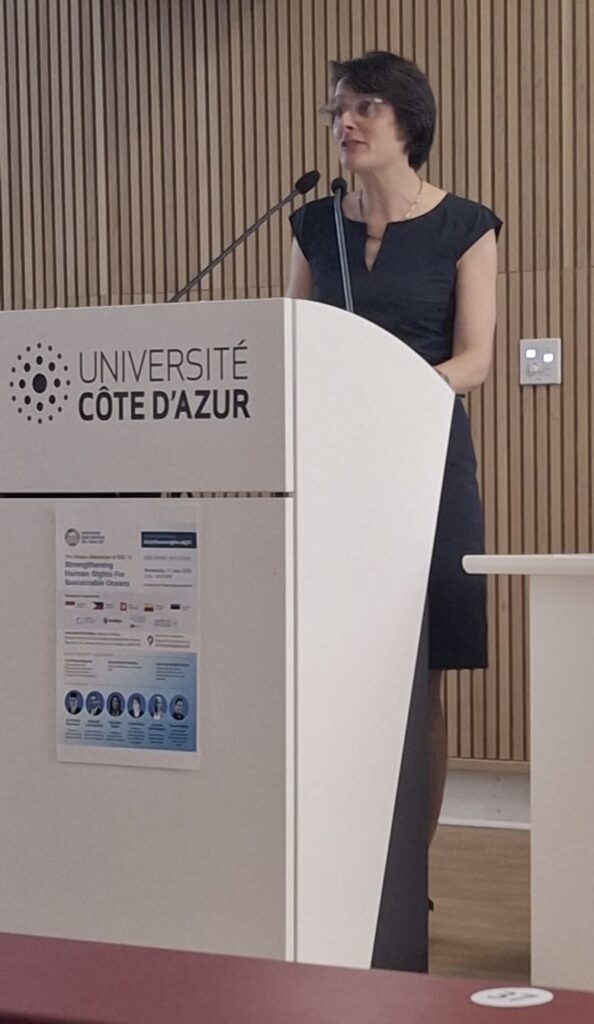
- Professor Irini Papanicolopulu, British Academy Global Professor of International Law at SOAS University of London and Vice-Chair of BlueRights
- Dr Mas Achmad Santosa, Chief Executive Officer of the Indonesia Ocean Justice Initiative
- Professor Jean-Christophe Martin, Professor of Public Law and Director of the Institut de la Paix et du Développement at Université Côte d’Azur
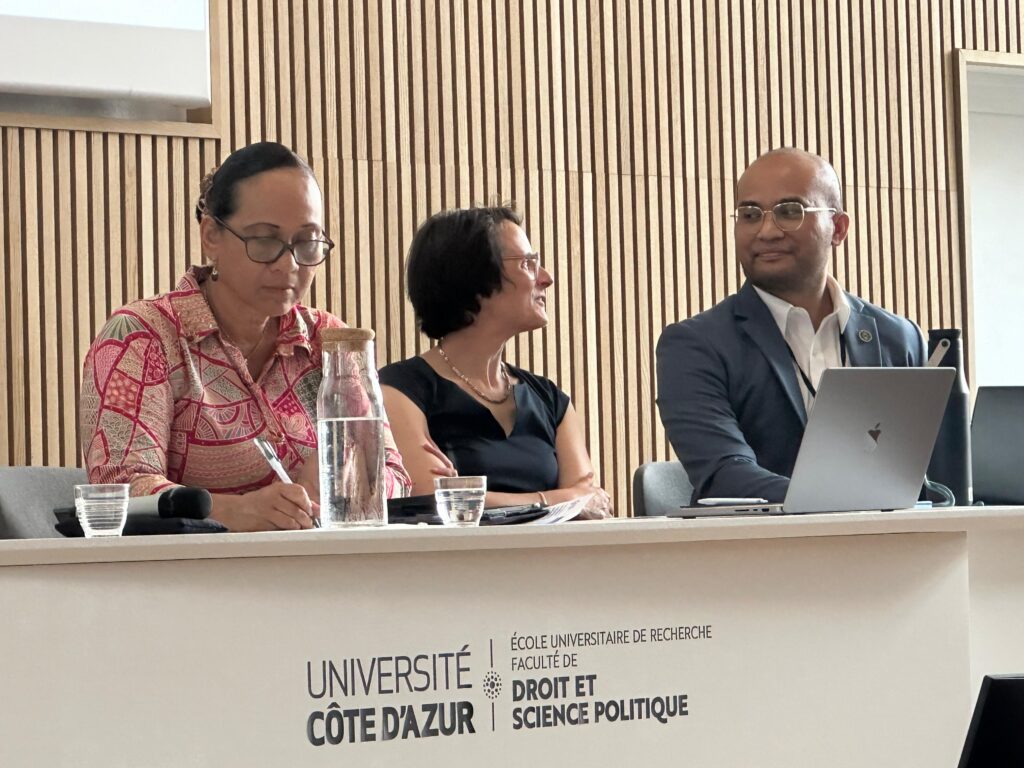
The high-level panel brought together:
- Ambassador Arif Havas Oegroseno, Vice Minister of Foreign Affairs of Indonesia
- Marshall Louis Alferez, Assistant Secretary, Department of Foreign Affairs of the Philippines
- Ambassador Elizabeth Taylor, Special Envoy for the Oceans, Colombia
- Professor Anna Petrig, Professor of International Law at the University of Basel and Chair of BlueRights
- Jeremia Humolong P., Programme Manager, Indonesia Ocean Justice Initiative
- S. M. Masum Billah, Visiting Fellow, Laboratoire de Droit International et Européen, Université Côte d’Azur
Why human rights belong in SDG 14
The event challenged the tendency to discuss sustainable oceans primarily through environmental protection, biodiversity, fisheries management, and resource use.
Instead, speakers brought the people behind those activities into focus.
The discussion highlighted the connection between sustainable ocean governance and the protection of people at sea, including fishers and migrant workers whose labour sustains major parts of the global maritime economy but whose rights and working conditions can remain largely invisible.
Particular attention was given to the role of international law and governance in ensuring that ocean-related activities do not come at the expense of human rights. The exchange also underlined the importance of cooperation across States, international organisations, academia, and civil society in closing protection gaps and translating legal standards into practice.
For BlueRights, the message was clear: protecting the ocean and protecting the people who depend on it are not competing agendas. They are part of the same challenge.
From discussion to commitment
The event was also connected to a formal voluntary commitment registered within the United Nations Ocean Commitments framework:
The Human Dimension of SDG 14: Strengthening Human Rights for Sustainable Oceans
#OceanAction59068
Registered by the University of Basel in connection with BlueRights, the commitment places the protection of people at sea within the wider implementation of SDG 14 and reinforces the need to integrate human rights considerations into sustainable ocean governance.
This matters because voluntary commitments were a central part of the 2025 UN Ocean Conference process, translating conference discussions into concrete pledges by governments, academic institutions, civil society organisations, and other stakeholders.
Why the event mattered for BlueRights
The side event marked an important step in taking BlueRights beyond the research community and into a major international ocean-governance forum.
It connected the Action’s work on the rights to life, liberty, and health at sea with the broader sustainability agenda and created space for dialogue with governments and organisations working directly on fisheries, maritime labour, ocean governance, and international cooperation.
It also strengthened collaboration with the Indonesia Ocean Justice Initiative — a relationship that later developed further through a Memorandum of Understanding between BlueRights and IOJI.